



 MENU
MENURight now, four astronauts aboard the Orion capsule are hurtling toward Earth at nearly 25,000 miles per hour. In the minutes it takes the capsule to slow down and splash down, the heat shield on Orion’s base will reach temperatures exceeding 5,000 degrees Fahrenheit, hot enough to vaporize steel. The fact that this is survivable is not an accident. It is the result of years of painstaking simulation, testing, and analysis.
Some of that foundational work was done with Tecplot 360.
Over A Decade of Groundwork
Back in 2015, we published a story about how NASA engineers used Tecplot 360 to analyze the heat shield for Orion’s first test flight, Exploration Flight Test 1 (EFT-1). The team ran approximately 2,000 simulations using two NASA-developed CFD solvers: DPLR (Data Parallel Line Relaxation) and LAURA (Langley Aerothermodynamic Upwind Relaxation Algorithm). Both tools model the extreme physics of atmospheric re-entry – the insane temperature gradients, immense pressure, and breakneck speeds.
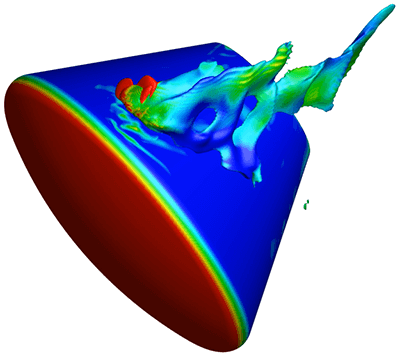
Image of temperature contours of the plume and on the vehicle’s surface shows potential heating augmentation on the aftbody of the Orion MPCV capsule. Image courtesy of www.nasa.gov.
Tecplot 360 served as the post-processing layer: the place where engineers could take raw simulation output and turn it into something they could actually see, interrogate, and trust.
That work helped validate that Orion could survive re-entry. EFT-1 proved it in practice. And the data and methods developed during that period became part of the engineering heritage that carries forward to every subsequent Orion mission, including Artemis II.
Why This Moment Matters
The Artemis II re-entry is the first time since Apollo 17 in 1972 that humans have returned from lunar distance. The re-entry corridor is narrower, the speeds higher, and the stakes immeasurably greater than any unmanned test. The heat shield is not a component that gets a second chance.
Tecplot 360 exists precisely for moments like this. They give engineers the confidence, before any human ever boards the vehicle, that the physics have been understood, and the margins are safe.
Trusted When The Stakes Are Highest
There is a meaningful difference between a visualization tool and a decision-making tool. Many applications can render CFD data. Far fewer are trusted by working engineers to deliver the consistent, accurate, repeatable results that high-stakes programs demand. When a NASA team runs 2,000 simulations to determine whether a heat shield will hold, they are building a case. The tool they use to analyze those results has to be one they can stake their professional judgment on.
Tecplot was founded by Boeing engineers who understood that world firsthand. Aerospace and defense is not a market Tecplot adapted to; it is the environment the software was born in. Tecplot 360 was designed from the ground up to help engineers interrogate complex simulation data, identify what matters, and arrive at defensible conclusions. In programs where design decisions carry real consequences, that distinction is an engineering requirement.