


 MENU
MENU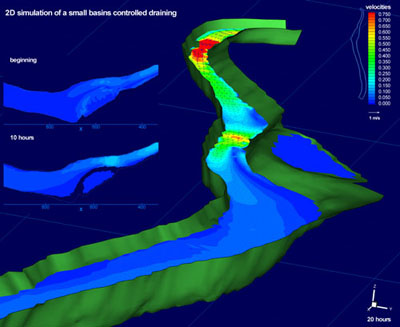
2D Simulation of Basin’s Controlled Draining
Using numerical simulation models to predict the flow of sedimentation and erosion on water quality at lake and reservoir bottoms. […]

Using numerical simulation models to predict the flow of sedimentation and erosion on water quality at lake and reservoir bottoms. […]
Contributed by Michael J. Aftosmis NASA Advanced Supercomputing Division, NASA Ames Research Center The Engineers Michael Aftosmis (NASA) and Scott Murman (ELORET) work at the NASA Advanced Supercomputing (NAS) Division at NASA Ames Research Center. NAS was founded in 1984 to develop, demonstrate, and deliver innovative, distributed heterogeneous computing capabilities to enable NASA projects and missions. Columbia Accident Investigation Board Results The plot is a composite image extracted from a […]
Contributed by: Dr. Craig Hunter, NASA Langley Research Center Noise Sources in a Jet Plume The jet plume in Figure 1 originates from a bypass ratio (BPR) typical of a transport aircraft. Noise sources are shown in a 12,500 Hz frequency band (sub-scale) with the observer at 88 degrees to the inlet. The data set has about 35 variables at 17 million cells. The bypass ratio relates the size of […]
Contributed by Eric Jal, Sr. Engineer, Energy Div. Connell Wagner, Melbourne, Australia Ventilation is a key design factor for the new Melbourne Cricket Ground (MCG). Using PHOENICS to optimize the design, CFD and Tecplot have been used to analyze air movement within the building and in external areas. In this image we see relative changes in air movement patterns across the pitch due to the construction of the new Northern […]