


 MENU
MENU
Helping to Design Internal Combustion Engines for Alternative Fuels
Researchers at Sandia National Labs are using some of the world’s fastest supercomputers to study the burning processes associated with a variety of fuels. […]

Researchers at Sandia National Labs are using some of the world’s fastest supercomputers to study the burning processes associated with a variety of fuels. […]
Finding a solution may help lift FAA restrictions on supersonic flight in U.S. and open lucrative new markets for supersonic business travel. […]
Pioneering simulation methods should aid device development and evaluation, and could eventually lead to personalized devices […]
Contributed by Dr. Haibo Dong Manager, Wright State University For the first time in history, researchers have been able to create a detailed 3D numerical simulation of a dragonfly in free flight. On the left is a high-speed movie of a dragonfly taking off. The black spots on the wing are 0.5mm ink markers that help track exact wing positions when creating the 3D shapes using films shot from different […]
Contributed by Shen Heping, Software Development Manager, Hong Yuan Tech. Cars that ride more quietly. Higher-quality acoustics in auditoriums. Aircraft that meet or noise pollution regulations. These are just a few examples of how scientists and engineers can develop more comfortable, enjoyable, or environmentally-sound products by studying the source and distribution of noise. The ability to actually see the noise distribution or what’s going on around the noise source helps […]
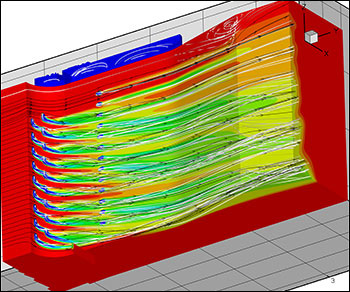
Using advanced software tools to study the physics of airflow and how it impacts the performance of aircraft engines. […]
Contributed by Sylvain Gravel Hydro-Québec The Challenge: Accurately Visualizing Magnetic Flux Density In working with electrical power production and distribution, a key problem faced is being able to see the unseen – in other words, how does one view invisible electrical and magnetic forces at play? Hydro-Québec needed to be able to see magnetic flux density near a distribution power line, which is essentially understanding the power flow in the […]
Contributed by Dr. Baki Farouk Drexel University Problem Statement: Numerical simulations of the standing wave and acoustic streaming in a resonator filled with nitrogen (Fig. 1) are presented. The initial gas pressure in the resonator is 1 atm (101 KPa), and temperature is 300 K. The vibrational frequency of the left wall is chosen as f = 20 kHz. The corresponding wavelength of the sound wave at this frequency is […]
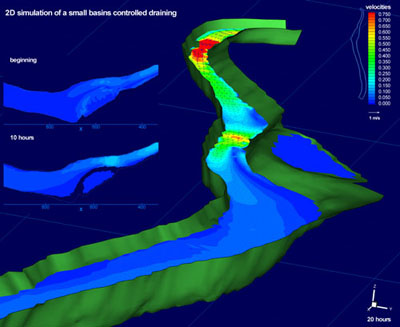
Using numerical simulation models to predict the flow of sedimentation and erosion on water quality at lake and reservoir bottoms. […]